Posted by Zoe Parker
Filed in Technology 17 views
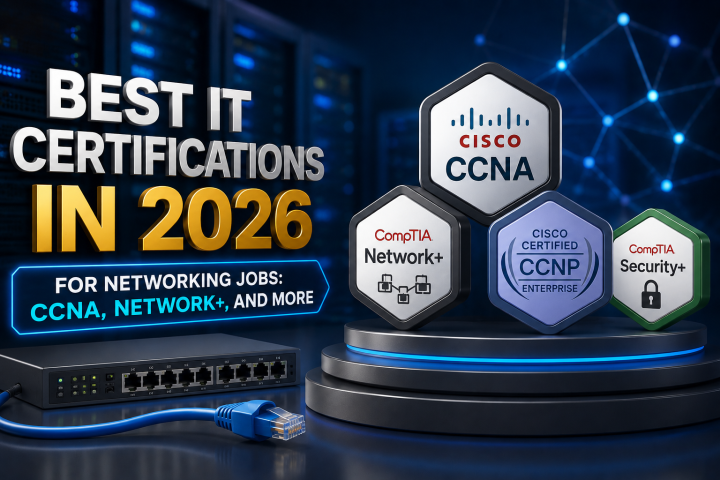
Networking is still one of the strongest entry points into IT because almost every business depends on reliable connectivity. Cloud platforms, remote work, cybersecurity tools, wireless systems, and data centers all need professionals who understand how networks operate. In 2026, the best networking certification depends on your current skill level and the job role you want next.
Some candidates need a beginner-friendly credential before applying for help desk or junior support roles. Others already understand routing, switching, and troubleshooting and want a stronger certification for network administrator or network engineer positions. The right certification should match your experience, not just the most popular name.
Before choosing a certification, decide whether you want a support, administrator, engineer, security, or cloud networking role. A help desk technician may need basic networking knowledge. A network administrator needs stronger troubleshooting and configuration skills. A network engineer may need deeper routing, switching, wireless, automation, security, or cloud networking knowledge.
This is why certifications like CCST Networking, CompTIA Network+, Cisco CCNA, JNCIA-Junos, Fortinet FCP Secure Networking, and Cisco CCNP Enterprise all serve different purposes. They are not equal replacements. They are steps for different career stages.
| Certification | Best For | Main Focus | Good Career Fit |
|---|---|---|---|
| Cisco CCST Networking | Absolute beginners | Entry-level networking concepts | Help desk, IT support, junior network support |
| CompTIA Network+ | Early networking candidates | Vendor-neutral networking, operations, security, troubleshooting | Network technician, support specialist |
| Cisco CCNA | Cisco-focused networking learners | Network fundamentals, access, IP connectivity, security, automation | Network admin, junior network engineer |
| JNCIA-Junos | Juniper networking path | Junos OS, routing basics, monitoring, configuration | Juniper support, network operations |
| Fortinet FCP Secure Networking | Network security professionals | Fortinet secure networking products | Firewall admin, network security technician |
| Cisco CCNP Enterprise | Experienced networking professionals | Enterprise networking, automation, infrastructure, assurance | Network engineer, enterprise engineer |
Cisco CCST Networking is a useful starting point if you are very new to networking. Cisco says the 100-150 CCST Networking exam validates entry-level networking concepts and shows foundational knowledge of how networks operate, including devices, media, and protocols. Cisco also describes it as a first step toward CCNA.
This certification can help candidates who are not ready for CCNA yet. It fits people moving from general IT support into networking or students who need a simple foundation before advanced topics. It is not the strongest credential for network engineer roles, but it can help you build confidence before moving to Network+ or CCNA.
CompTIA Network+ is one of the best certifications for people who want broad networking knowledge without focusing on one vendor. The current N10-009 exam includes up to 90 questions, multiple-choice and performance-based question types, a 90-minute test length, and a recommended 9–12 months of networking experience. Its domains include Networking Concepts, Network Implementation, Network Operations, Network Security, and Network Troubleshooting.
Network+ is a smart choice for candidates who want roles such as network support technician, help desk technician with networking duties, junior administrator, or IT support specialist. It teaches a wide view of networking, including cabling, wireless, cloud concepts, IP addressing, monitoring, documentation, security basics, and troubleshooting.
Choose Network+ if you want flexibility. It is not tied to Cisco, Juniper, Fortinet, or any single platform. That makes it helpful for candidates who work in mixed environments.
CCNA is usually the strongest associate-level certification for networking jobs. Cisco’s current 200-301 CCNA v1.1 exam is 120 minutes and tests network fundamentals, network access, IP connectivity, IP services, security fundamentals, automation, and programmability. Also, can watch the video on CCNA 200-301 V2.0 update coming in Feb 2027.
CCNA is a better choice than Network+ if your goal is to work directly with Cisco-based infrastructure or move toward network administrator and junior network engineer roles. It goes deeper into practical networking than many entry-level certifications. Candidates should expect to study subnetting, switching, routing, VLANs, wireless basics, ACLs, NAT, routing protocols, and automation concepts.
For many networking careers, a strong path is Network+ first, then CCNA. But if you already have networking basics and want a more job-focused credential, you can start with CCNA directly.
JNCIA-Junos is valuable if you work with Juniper devices or want to enter environments that use Junos OS. Juniper describes JNCIA-Junos as designed for networking professionals with beginner-to-intermediate knowledge, and the exam verifies understanding of core Junos OS functionality. The current exam code listed by Juniper is JN0-106, with 65 multiple-choice questions and a 90-minute length.
This certification covers networking fundamentals, Junos OS fundamentals, user interfaces, configuration basics, operational monitoring, maintenance, routing fundamentals, routing policy, and firewall filters.
JNCIA-Junos is not always the first certification for every networking candidate. However, it becomes highly useful if your target employer uses Juniper equipment or if you want to stand out beyond the common Cisco path.
Modern networking jobs often overlap with cybersecurity. Firewalls, secure wireless, network access control, VPNs, segmentation, and monitoring are now normal parts of network operations. Fortinet FCP Secure Networking is useful for candidates who want a network security direction.
Fortinet says the FCP in Secure Networking certification validates the ability to secure networks and applications by deploying, managing, and monitoring Fortinet network security products. Current requirements include passing the NSE 4 exam and one NSE 5 exam within two years, and the certification remains active for two years from the date of the second exam.
This is a better option after you already understand basic networking. It is especially helpful for firewall administrators, network security technicians, and professionals working with FortiGate, FortiManager, FortiSwitch, or secure wireless environments.
CCNP Enterprise is not a beginner certification. It is better for professionals who already have networking experience and want to move into deeper enterprise roles. Cisco describes the 350-401 ENCOR exam as a 120-minute exam testing core enterprise network technologies, including dual-stack IPv4 and IPv6 architecture, virtualization, infrastructure, network assurance, security, and automation.
Choose CCNP Enterprise after CCNA or after real-world network administration experience. It can support roles such as network engineer, enterprise network engineer, infrastructure engineer, or senior network administrator.
Cloud networking is important in 2026, but candidates should be careful with AWS Certified Advanced Networking - Specialty. AWS states that this exam is being retired, and the last day to take it is August 25, 2026. Certifications earned before retirement remain active for the standard three-year period, but new certifications will not be issued after retirement.
That means it may still make sense for candidates already prepared and testing before the retirement date. For new learners, it is better to focus on cloud networking skills through updated AWS training, hands-on labs, and future AWS certification changes.
For complete beginners, start with Cisco CCST Networking or Network+. If you already know IT basics, Network+ gives a stronger vendor-neutral foundation. After that, CCNA is usually the best next step for serious networking roles.
If your workplace uses Juniper, add JNCIA-Junos. If your job involves firewall work or secure networking, consider Fortinet FCP Secure Networking. If you already have real experience and want enterprise-level growth, move toward CCNP Enterprise.
During preparation, use official exam objectives, labs, subnetting practice, command-line exercises, and scenario-based questions. Cert Empire (certempire.com) can be used once as a practice resource during final review, but candidates should avoid memorization-only study and focus on real networking skills.
The best networking certification in 2026 depends on your starting point. Network+ is a strong vendor-neutral foundation. CCNA is the best associate-level option for many network jobs. CCST helps beginners, JNCIA-Junos supports Juniper-focused roles, Fortinet FCP adds secure networking value, and CCNP Enterprise fits experienced professionals.
Do not choose a certification only because it is popular. Choose the one that matches your current skill level, target job, and the network technologies you want to work with.
CCNA is usually stronger for dedicated networking roles, while Network+ is better for vendor-neutral basics. Beginners may start with Network+ before moving into CCNA.
A complete beginner can start with Cisco CCST Networking or CompTIA Network+. Both build foundations, but Network+ gives broader coverage for entry-level IT networking roles.
No, CCNP Enterprise is not ideal for beginners. It fits professionals who already understand routing, switching, troubleshooting, enterprise infrastructure, and network automation concepts.
Certifications help, but employers also value hands-on labs, troubleshooting practice, subnetting skills, documentation ability, and confidence with real network tools and scenarios.
Don’t miss this: PMP and CAPM: Everything You Need to Know Before Choosing